I and Thou, Trans. Kaufmann by Martin Buber
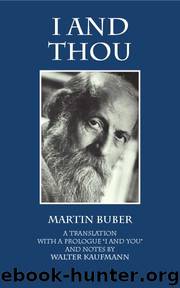
Author:Martin Buber [Buber, Martin]
Language: eng
Format: mobi
Published: 2011-05-16T16:00:00+00:00
The Brahmana of the hundred paths relates that the gods and the demons were once engaged in a contest. Then the demons said: “To whom shall we offer our sacrifices?” They placed all offerings in their own mouths. But the gods placed the offerings in one another’s mouth. Then Prajapati, the primal spirit, bestowed himself upon the gods.
*
—One can understand how the It-world, left to itself, untouched and unthawed by the emergence of any You, should become alienated and turn into an incubus; but how does it happen that, as you say, the I of man is deactualized? Whether it lives in relation or outside it, the I remains assured of itself in its self-consciousness, which is a strong thread of gold on which the changing states are strung. Whether I say, “I see you” or “I see the tree,” seeing may not be equally actual in both cases, but the I is equally actual in both.
—Let us examine, let us examine ourselves to see whether this is so. The linguistic form proves nothing. After all, many a spoken You really means an It to which one merely says You from habit, thoughtlessly. And many a spoken It really means a You whose presence one may remember with one’s whole being, although one is far away. Similarly, there are innumerable occasions when I is only an indispensable pronoun, only a necessary abbreviation for “This one there who is speaking.” But self-consciousness? If one sentence truly intends the You of a relation and the other one the It of an experience, and if the I in both sentences is thus intended in truth, do both sentences issue from the same self-consciousness?
The I of the basic word I-You is different from that of the basic word I-It.
The I of the basic word I-It appears as an ego7 and becomes conscious of itself as a subject (of experience and use).
The I of the basic word I-You appears as a person and becomes conscious of itself as subjectivity (without any dependent genetive).8
Egos appear by setting themselves apart from other egos.
Persons appear by entering into relation to other persons.
One is the spiritual form of natural differentiation, the other that of natural association.
The purpose of setting oneself apart is to experience and use, and the purpose of that is “living”—which means dying one human life long.
The purpose of relation is the relation itself—touching the You. For as soon as we touch a You, we are touched by a breath of eternal life.9
Whoever stands in relation, participates in an actuality; that is, in a being that is neither merely a part of him nor merely outside him. All actuality is an activity in which I participate without being able to appropriate it. Where there is no participation, there is no actuality. Where there is self-appropriation, there is no actuality. The more directly the You is touched, the more perfect is the participation.
The I is actual through its participation in actuality. The more perfect the participation is, the more actual the I becomes.
Download
This site does not store any files on its server. We only index and link to content provided by other sites. Please contact the content providers to delete copyright contents if any and email us, we'll remove relevant links or contents immediately.
| Africa | Americas |
| Arctic & Antarctica | Asia |
| Australia & Oceania | Europe |
| Middle East | Russia |
| United States | World |
| Ancient Civilizations | Military |
| Historical Study & Educational Resources |
Cecilia; Or, Memoirs of an Heiress — Volume 1 by Fanny Burney(32558)
Cecilia; Or, Memoirs of an Heiress — Volume 2 by Fanny Burney(31956)
Cecilia; Or, Memoirs of an Heiress — Volume 3 by Fanny Burney(31941)
The Secret History by Donna Tartt(19085)
Sapiens: A Brief History of Humankind by Yuval Noah Harari(14389)
Leonardo da Vinci by Walter Isaacson(13336)
The Radium Girls by Kate Moore(12027)
Sapiens by Yuval Noah Harari(5369)
How Democracies Die by Steven Levitsky & Daniel Ziblatt(5218)
The Wind in My Hair by Masih Alinejad(5095)
Homo Deus: A Brief History of Tomorrow by Yuval Noah Harari(4918)
Endurance: Shackleton's Incredible Voyage by Alfred Lansing(4780)
Man's Search for Meaning by Viktor Frankl(4605)
The Silk Roads by Peter Frankopan(4533)
Millionaire: The Philanderer, Gambler, and Duelist Who Invented Modern Finance by Janet Gleeson(4478)
The Rape of Nanking by Iris Chang(4211)
Joan of Arc by Mary Gordon(4109)
The Motorcycle Diaries by Ernesto Che Guevara(4098)
Stalin by Stephen Kotkin(3965)
